
Nitrate-based nutrition increased yields and reduced the incidence of apical rot in fertirrigated tomato.
Fertigation, Fertigation, Germany, Germany, Greenhouse, Greenhouse, NH4+, Nitrate, Nitrate, NO3-, Tomato, Tomato,
Despite the fact that NO3- assimilation consumes more energy than NH4+ assimilation, few plant species perform well when NH4+ is the sole source of nitrogen, and many plants develop symptoms of toxicity when subjected to high NH4+ concentrations. Damage can be observed as leaf chlorosis, reduced net photosynthesis, lower plant yield, lower cation content, and changes in metabolite (residue) levels such as amino acids or organic acids.
To investigate whether grafting can ameliorate the negative effects of ammonium nutrition on a sensitive crop like tomato, three experiments were conducted between 2008 and 2009 in a completely randomized block design in a greenhouse in Germany. Tomato plants of the Moneymaker variety were either self-grafted or grafted onto the widely used (popular) "Maxifort" rootstock. For the first two experiments (in 4 replications), plants were transferred to 2 l glass vases (jars) filled with an aerated nutrient solution. Vegetative growth parameters and leaf nutrient content were evaluated. In the first experiment, the response of plants in the nutrient solution at pH 5 with a high NO3-: NH4+ rate was investigated. In the second experiment, the effect of grafting under four different rates of NO 3- : NH4+ in the nutrient solution, at a constant pH of 5.7±0.1 and a total of 23 mM N, was compared. In the third experiment, the effects of exposure of these two rates (ratios) of the two nitrogen sources were investigated on the nutrient content and yield of the plant, grown in furrows supplied with a continuous nutrient solution, at a plant density of 1.6 plants/m2, in two replicates of 6 plants per plot (Table 1).
The pH of the nutrient solution had no effect on plant growth or on leaf N, P or K content. The content of other nutrients in leaves 20 days after transplanting was affected: Ca, Mg, and Cu concentrations increased, and Fe, Mn, and Zn concentrations decreased when the pH of the nutrient solution increased from 3.5 to 7.5. This is in agreement with other models predicting the effect of pH on nutrient uptake by plants, but there were no significant interactions between grafting and pH response. Grafted plants had higher Ca, Fe, Zn, and Cu concentrations compared to self-grafted plants, but there were no significant interactions between grafting and pH response.
In the second and third experiments, leaf biomass and fruit yield decreased in response to increased NH4+ in the nutrient solution, and macro- and microelement concentrations were also affected by the rate (ratio) of NO3-: NH4+. The grafting combination did not influence these parameters, and no interaction between N and graft forms was found.
The uptake of the major cations Ca2+ and Mg2+ was reduced with increasing external NH4+ concentrations (Table 1). This is explained by the mechanism of charge balances in ion uptake, when the uptake of ammonium cations prevents the uptake of other cations to maintain electrical neutrality in the plant. In this experiment, the reduction in plant growth and yield is explained by this low concentration of calcium and magnesium in the leaves. Calcium deficiency during NH4+ nutrition can induce loss of membrane integrity, lowering magnesium concentration and negatively affecting the function of mitochondria and chloroplasts. This explanation is based on gas exchange measurements during this experiment, which showed a significant decrease in photosynthetic activity in 70 to 100% of the treatments. The decrease in marketable yield with increasing NH4+ in the nutrient solution resulted mainly from increased physiological fruit disorders - blosson end rot (BER), reducing the number of marketable fruits per plant. The incidence of BER in this experiment decreased with increasing ammonium concentration in the nutrient solution, and correlated negatively with calcium content in tomato fruits and leaves (Table 1). Grafting of the variety 'Moneymaker' onto the rootstock 'Maxifort' did not alleviate the negative effects of ammonium fertilization on a sensitive crop such as tomato.
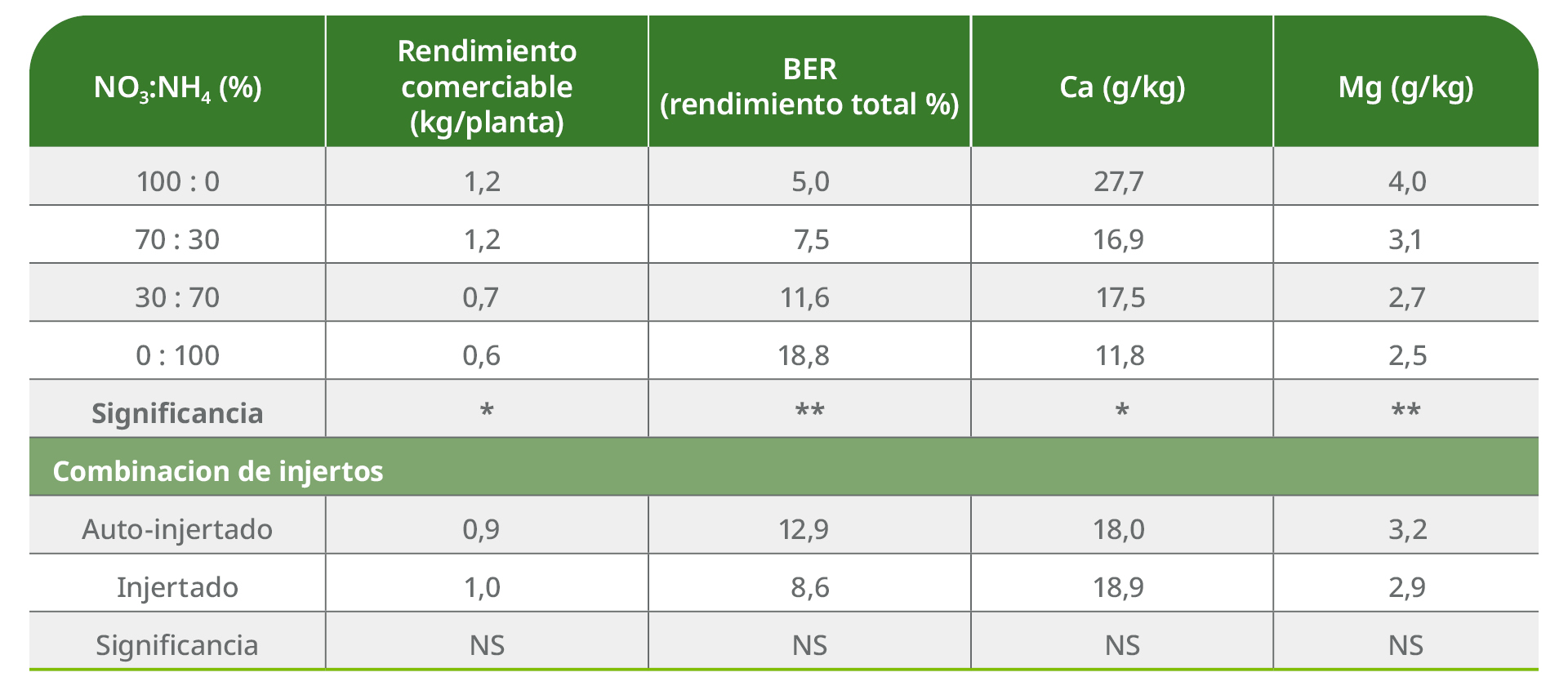
Table 1. Effect of the NO3-:NH4+ ratio of the nutrient solution on yield, blossom end rot (BER) and leaf nutrient content in fertigated tomato. Nitrogen type had a significant effect on all parameters, but no statistically significant variation was found among grafting combinations (two-way ANOVA with a significant linear effect at p≤ 0.05 (*) or 0.01(**). NS=not significant).
Autor
Borgognone, D., G. Colla, Y. Rouphael, M. Cardarelli, E. Rea and D. Schwarz, 2013. Effect of Nitrogen Form and Nutrient Solution pH on Growth and Mineral Composition of Self-Grafted and Grafted Tomatoes. Scientia Horticulturae, 149: 61-69.