
Effect of nitrate/ammonium/urea ratios and potassium concentrations on tomato seedling production.
Cultivation, Cultivation, Cultivation, Greenhouse, Greenhouse, Sheet, Sowing, Stem, Stem,
In Mexico, tomato seedlings are propagated in greenhouses prior to transplanting into open field tomato crops. Most of the substrates used during propagation do not contain sufficient amounts of nutrients to satisfy the seedling requirement for optimal development. In this study, the objective was to evaluate the effect of nitrogen form on this crop. From information found in the literature, it is already known that replacing a small proportion of nitrogen-nitrate with ammonium can improve plant growth. Additionally, the effect of increasing the potassium dose was studied, because potassium is the second major element required by tomato plants and can mitigate the potentially negative effects of ammonium in the nutrient solution. In this study, a completely randomized factorial experimental design was used to evaluate the effect of four proportions of NO3- /NH4+ /urea and two concentrations of potassium in the nutrient solution on seedling growth and plant mineral composition.
Seeds were sown in polystyrene containers with 30 cm3 holes filled with a 1:1 mixture of meadow vermiculite. Nutrient solutions were applied directly at seed germination until the end of the experiment, 46 days after sowing. The nutrient dosage was increased stepwise every 10 days from 50% to 75%, until 100% of the final concentration of both cations and anions of 20 mol/m3 was reached. Steiner's recipe for the nutrient solution was modified, with 12 mol/m3 N as standard. Table 1 shows the four treatments with different doses of the three N sources. Potassium was applied at two concentrations, 7 and 9 mol/m3.
The results showed that a number of parameters describing seedling quality increased when 15% of the total nitrogen-nitrate was replaced by a similar amount of urea or a mixture of ammonium and urea (Table 1). The mineral composition of leaves and roots also responded to the treatments. At 7 mol/m3 K, the N content of leaves and roots increased when 15% of NO3- was replaced by any of the other N sources (Figures 1 and 2). The P content of leaves and roots increased when 15% of NO3- was replaced by ammonium, but remained at similar levels when replaced by urea.
An interaction between the dose of the N source and the amount of K in the nutrient solution was observed on the concentration of N in leaves, stems and roots, and on the content of calcium or magnesium in the roots. Increasing the dose of K in the nutrient solution decreased the amount of N accumulated in the leaves in the presence of ammonium (85/15/0) compared to the standard dose of K. Increasing the dose of K decreased the amount of N accumulated in the roots in the presence of urea (85/15/0 and 85/7.5/7.5). Calcium and magnesium uptake in the roots was not affected by increasing the K dose, except when 15% urea was added, in which case the concentration of cations in the roots was reduced.
Table 1. Response of tomato seedling quality indicator parameters in relation to different nutrient solutions with doses of three N sources. Averages followed by equal letters are not significantly different (Tukey, P ≤ 0.05).
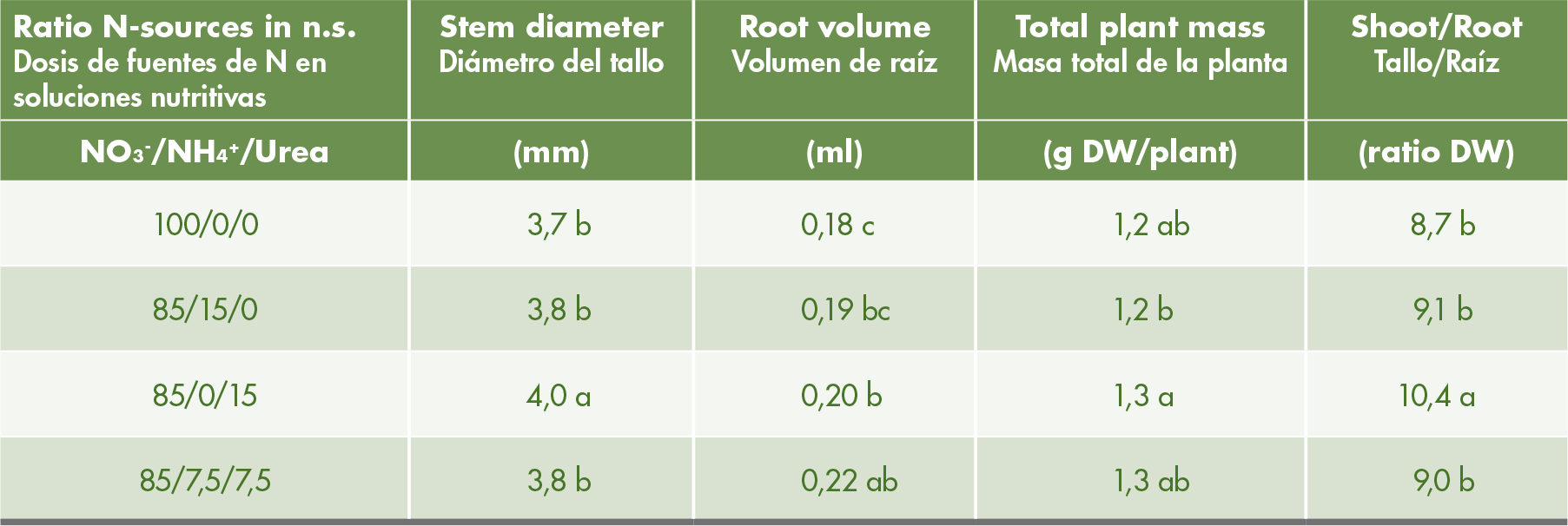
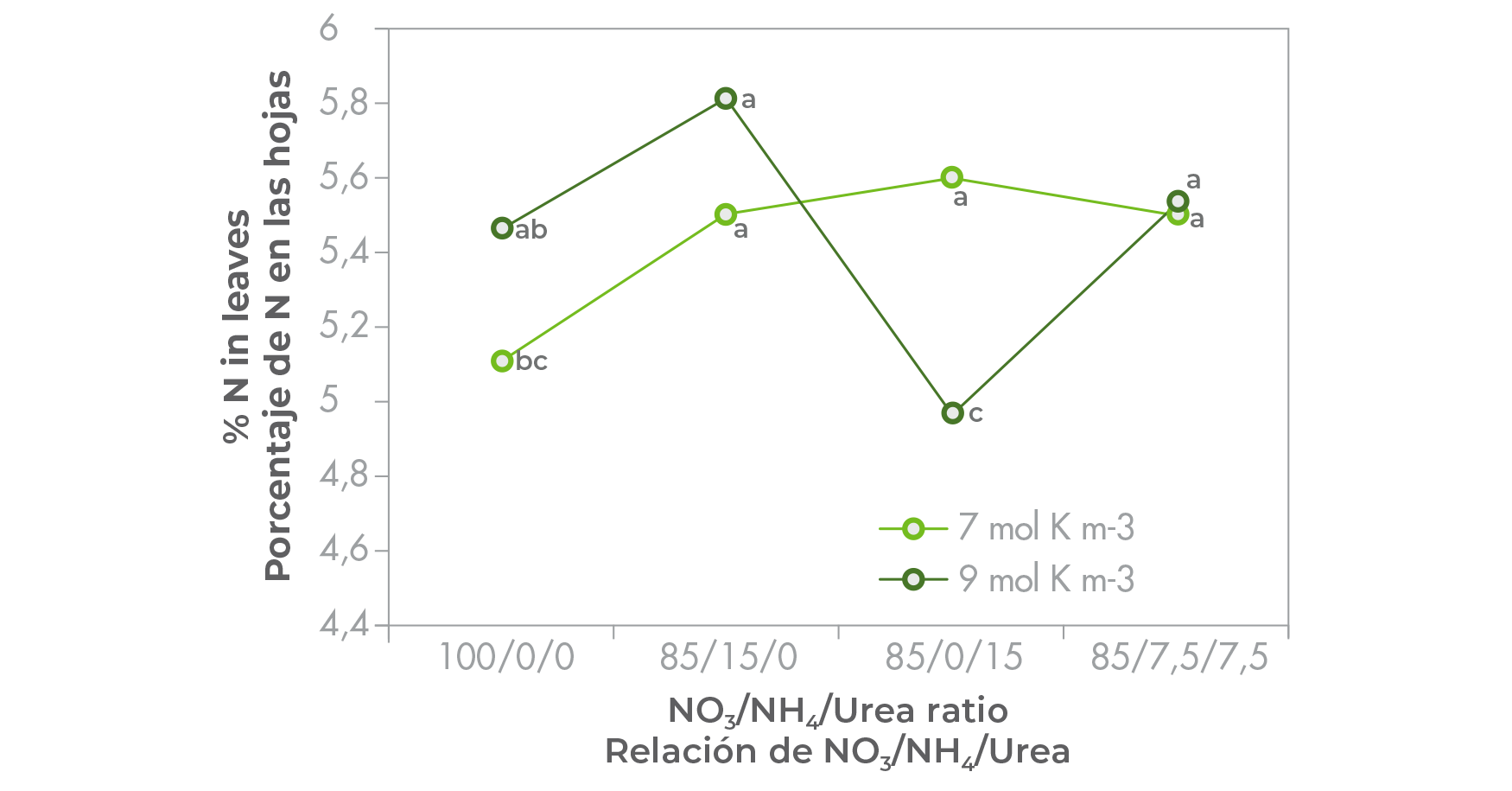
Figure 1. Percentage of nitrogen (N) in leaves of tomato seedlings supplied with nutrient solutions containing three different N sources at 4 doses, and 2 doses of potassium (K). Data points designated with the same letters in each column and row are not significantly different (Tukey, P ≤ 0.05).
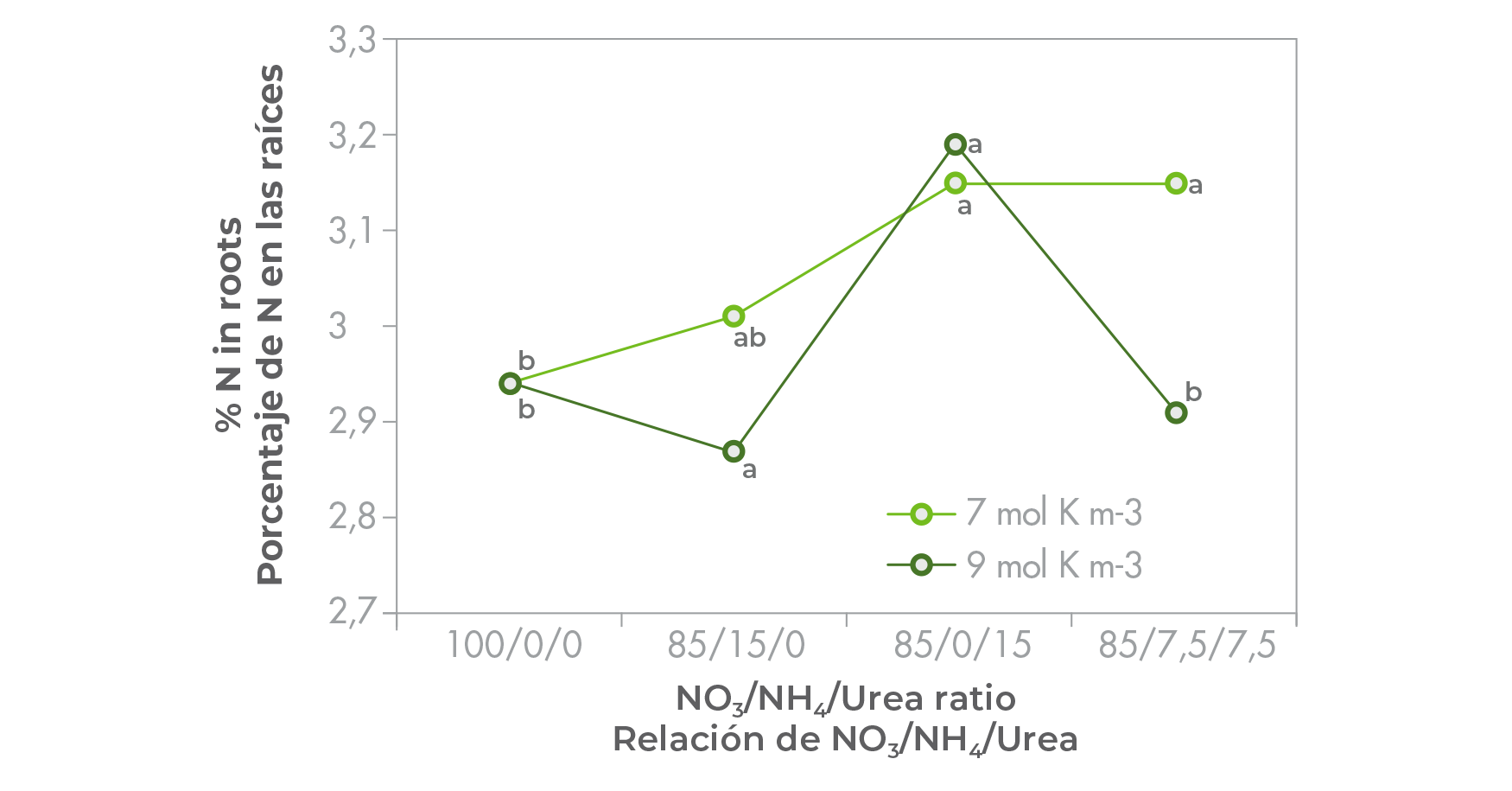
Percentage of nitrogen (N) in roots of tomato seedlings supplied with nutrient solutions containing three different N sources at 4 doses, and 2 doses of potassium (K). Data points nominated with the same letters in each column and rows are not significantly different (Tukey, P ≤ 0.05).
Autor
Parra-Terraza S., E. Salas-Núñez, M. Villarreal-Romero, S. Hernández-Verdugo, P. Sánchez-Peña, 2010. Nitrate/ammonium/urea proportions and potassium concentrations in the production of tomato seedlings. Rev. Chapingo Ser.Hortic 16 (1): 37- 46.